How to Get Better at Size It Up: Train Your Eye for Scale
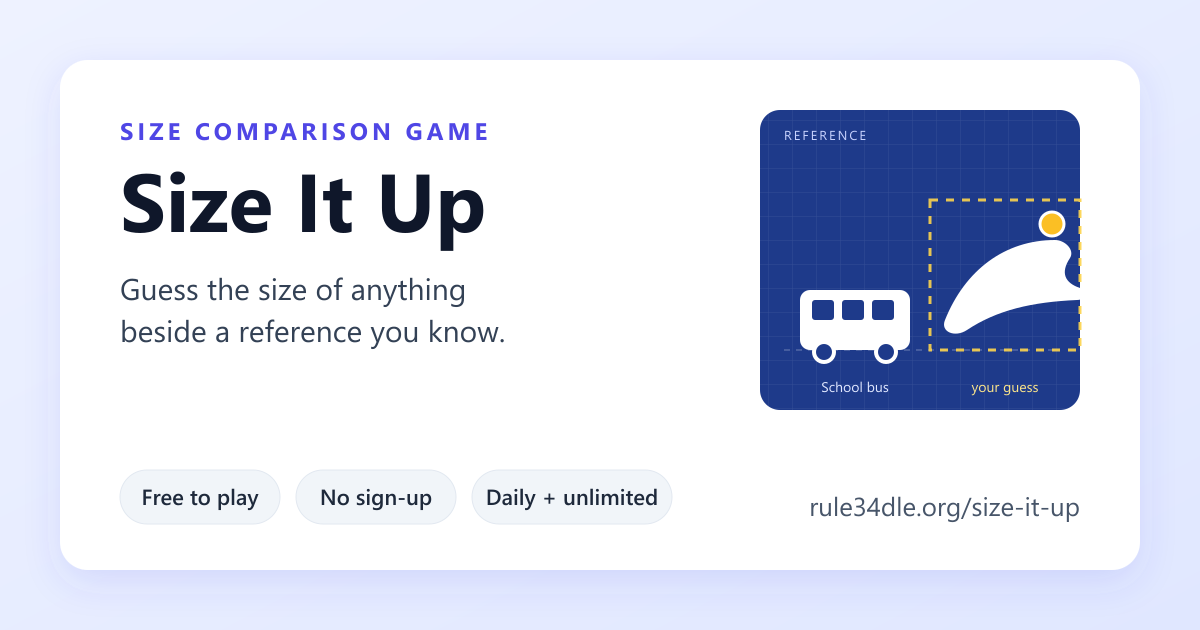
Size It Up puts a reference you know beside a mystery silhouette and asks you to resize the silhouette until the scale looks true. Five rounds, 100 points each, 500 for a perfect run. Most first runs land between 150 and 300. The gap between that and 400 is not knowledge. It is six habits that correct for how the eye gets size wrong, and each one is learnable in a few unlimited runs.
1. Count in references, never in metres
The blue reference on the left is the only thing on the board with a known size, and the game does not even tell you what that size is. So make it your unit. Instead of asking how long a blue whale is, ask how many school buses fit along one. "About two" is a judgment the eye can make; "25 metres" is a fact you either remember or do not. Then pull the corner until the red silhouette is two buses, and lock in. Players who think in references stop making the 200% misses that empty a round.
2. Decide the direction before you touch the corner
Size It Up starts the red silhouette at exactly the reference's size along the measured dimension, so the first thing on screen is an anchor that says "equal". Do not drag yet. Say to yourself whether the mystery is bigger or smaller, and roughly by how much, then move. People who drag first and think second almost always stop too close to the starting point, because the anchor pulls every adjustment back toward it.
3. Push past the comfortable answer for anything extreme
In 1910 Hollingworth showed that estimates drift toward the middle of whatever range is on offer: big things are guessed too small, small things too big. You can watch this happen in your own Size It Up snapshots. If a whale next to a bus already feels enormous, it is probably bigger still; if a honey bee beside a credit card looks absurdly tiny, make it tinier. When the silhouette runs out of board, press the zoom-out button and keep going. The extreme answers live past the edge, and the board was built to get you there.
4. Lean small when you are lost
The score is based on the error as a share of the true size, and that makes it lopsided. Guessing half of the real figure is 50% out and scores 45. Guessing double is 100% out and scores about 21. Guessing triple scores nothing. So when two guesses feel equally plausible, the smaller one is the cheaper mistake. This is not a reason to undershoot everything, because the third habit still applies to things you know are huge, but it is the tiebreaker for a coin flip.
5. Use the second dimension as a free check
Every silhouette has a width as well as a height. If your guess for a bus beside a giraffe implies a bus taller than a house, or a mountain shorter than the tree beside it, the number is wrong no matter how right it feels. Glance across the board before locking in and ask whether the pair could exist in the same photograph. This takes one second and catches the errors that would otherwise score zero.
6. Read the snapshots, not just the scores
The results screen keeps a picture of every reveal: your red guess beside the grey ghost at the true size. Four snapshots where the red shape is smaller than the ghost are one habit, not four mistakes, and the next run is where you fix it. Hover each round, note which way you missed and by how much the "Off by" line says, and carry that correction into the next unlimited run.
Putting it together in a run
Every round is worth the same 100 points, so there is no safe round to coast through and no ×3 finale to panic over. Round one pairs things close together: count in references and lock in. By round five the pair is far apart, and this is where the push-past-comfortable rule earns its keep. Slow down, decide the direction, count the references, zoom out if you need room, check the other dimension, then commit.
Play the unlimited mode until the daily puzzle feels easy, then go size something up and share the red squares.