How to Get Better at Fermi: A Practical Method for Estimation Questions
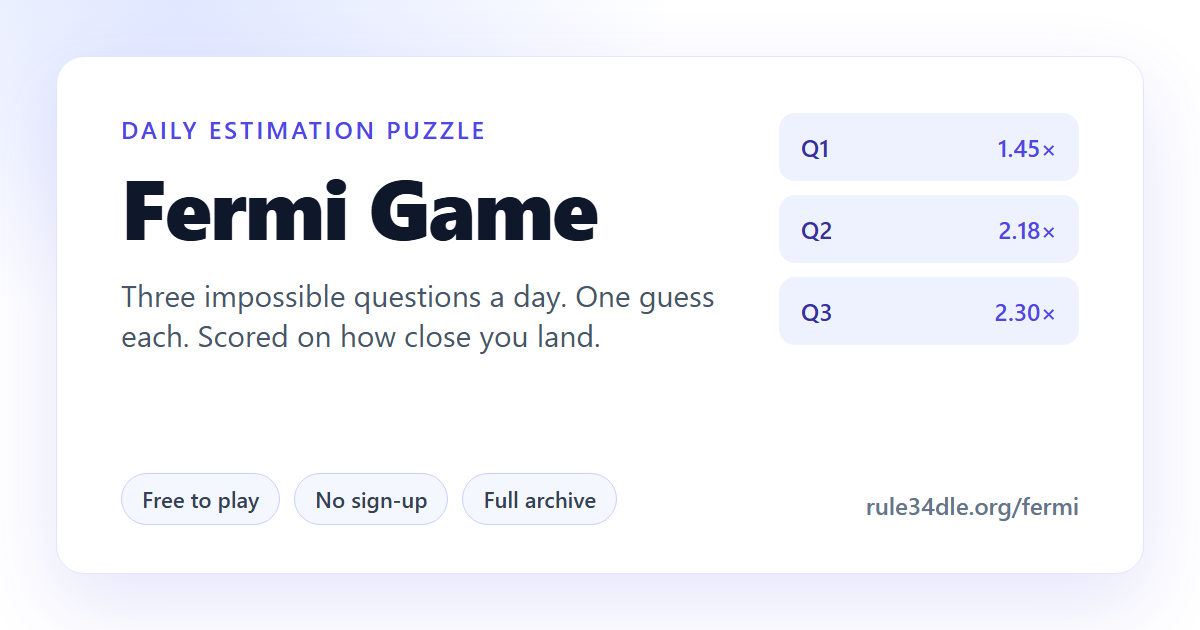
The Fermi game asks three questions a day with answers nobody knows, scores each guess as a multiple of the truth, and averages the three. Most new players sit somewhere between 3× and 6× for their first week. Getting under 2× is not about knowing more facts. It is about five habits that stop the big misses.
1. Name the type of quantity before you touch a number
Every question is one of three things. A stock: how many pet snakes live in England right now. A rate: how many Oreos are eaten in the US per day. A cumulative total: how many iPhones have been produced since 2007. The type decides which factors you need. A rate is a population times a per-person frequency divided by a time unit. A cumulative total is a rate times a number of years. A stock is a flow times a lifetime.
Players who skip this step produce the most common disaster on the results chart: a per-year number for a per-day question, which is a 365× miss no matter how good the rest of the reasoning was.
2. Write the chain, then fill it in
Do not reach for an answer. Reach for a product. For "how many steps does a mail carrier walk in a year", the chain is miles per day, times steps per mile, times working days per year. Three factors, each of which you can bound: perhaps 8 to 12 miles, about 2,000 steps per mile, roughly 250 working days. Multiply and you get around five million. The exact answer will differ, but the chain keeps you in the right order of magnitude.
The trick is to choose factors you can bound independently. If two factors are really the same uncertainty in disguise, their errors compound instead of cancelling.
3. Use the geometric mean, never the midpoint
This is the single largest improvement most players can make. When you are confident a factor lies between a low and a high bound, pick the square root of their product. Between 1,000 and 1,000,000 the midpoint is about 500,000 and the geometric mean is about 31,600. If the truth turns out to be 1,000, the midpoint is a 500× miss and the geometric mean a 32× miss. If the truth is a million, the midpoint is 2× and the geometric mean 32×. The geometric mean trades a slightly worse best case for a vastly better worst case, and because the game scores multiples, the worst case is what decides your average.
The built-in calculator in the game does square roots. Use it.
4. Keep a dozen anchors in your head
Almost every question decomposes into a few numbers that never change. World population around 8 billion. United States around 340 million people and 130 million households. United Kingdom around 68 million. A large city 8 to 9 million. About 30 million seconds, 8,800 hours and 365 days in a year. Around 2,000 steps in a mile. A school bus interior around 70 cubic metres.
Round them hard. Pretending to know the US population to four digits adds nothing when the next factor in your chain is a guess between 1 and 10.
5. Read the result back as a sentence
Before you lock in, translate the number. "Three hundred million Oreos a day" means roughly one per American per day. That is high but believable. "Thirty billion a day" means a hundred per person, which is absurd. A sentence exposes unit mistakes and missing time periods faster than staring at digits does.
After the reveal, read the game's own napkin math. It frequently uses a different decomposition from yours. When yours and theirs differ by a factor of ten, the factor you misjudged is usually obvious in the comparison, and that is the thing to remember for tomorrow.
A routine that works
Play today's three questions with the chain written down, even if only in your head. Then play one or two puzzles from the archive and look up the real answers afterwards to trace the full reasoning. Within a couple of weeks you will notice that question shapes repeat, and recognising the shape is most of the work.
Ready to practise? Play today's Fermi puzzle.