How to Get Better at the Color Game: Five Habits for a 40 out of 50
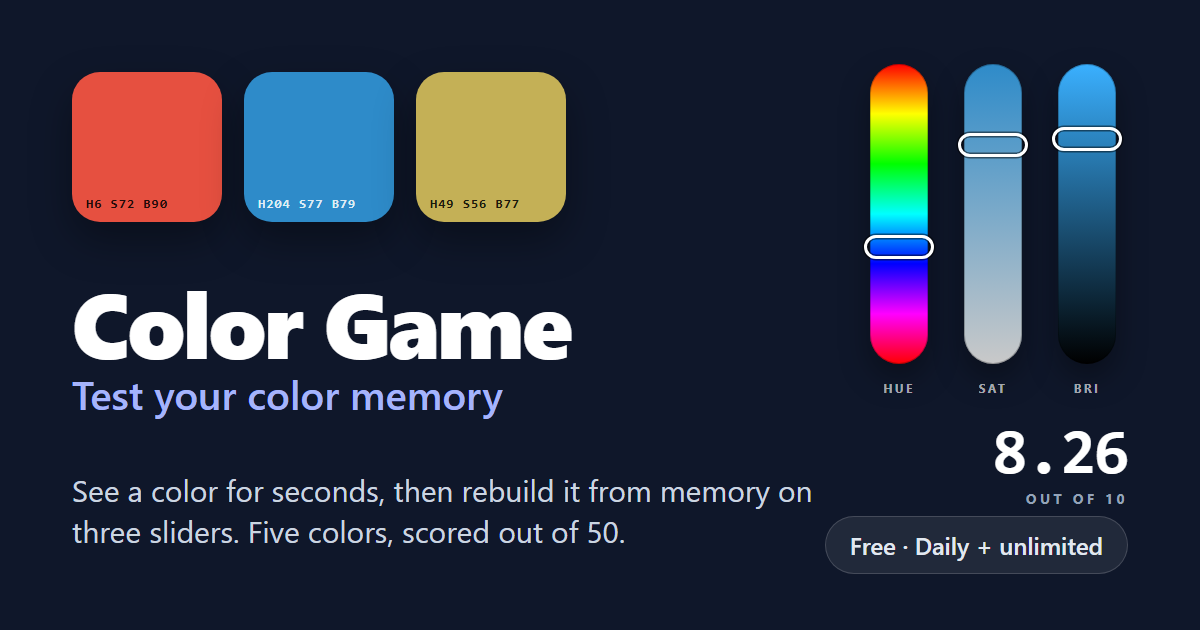
The color game shows you a color for a few seconds, takes it away, and asks you to rebuild it on hue, saturation and brightness sliders. Five colors, up to 10 points each, 50 for a perfect run. Most first runs on Easy land between 25 and 38, and the players who climb past 40 are not the ones with better eyes. They are the ones who learned which way their memory lies. Psychologists have been measuring those lies for sixty years, and each of the five habits below cancels one of them.
1. Name the color, then name the lean
Memory holds a color as a label plus an estimate of the exact shade, and the estimate fades first. In Bae and colleagues' 2015 experiments, colors reproduced from memory were pulled toward the center of their color category by up to ten degrees of hue, and a delay of under a second doubled the pull. "Blue" survives; "a blue that leans green and is a little gray" does not, unless you say it.
So say it. While the countdown runs, give the color its plain name, then give it two or three words of correction: leans green, slightly dusty, a bit dark. Those words are the part the label would otherwise erase, and they are cheap to carry across the gap. Players who do this stop making the one mistake that empties a round, which is rebuilding the typical version of the named color instead of the one they saw.
2. Spend the seconds on saturation and brightness
Hue is the easy thing to remember because it has a name. Brightness and saturation are the two things a name says nothing about, and the reveal will show you, round after round, that this is where the points go. Once you have the hue, which takes well under a second on a vivid color, stop looking at which color it is and ask two questions instead: how dark is this, and how gray is this. Attach a rough number to each, about 70 percent bright, about half saturated. Numbers survive the gap better than impressions.
This matters most on Hard and Brutal, where two seconds is enough to read the hue and almost nothing else. If you spend both seconds confirming that it is, yes, orange, you arrive at the sliders with nothing to set the other two by.
3. Set saturation a notch low
In 1960 Bartleson asked fifty people to pick the colors of grass, sky, brick and other familiar things from memory, and every one came back more saturated and lighter than the real thing. Memory exaggerates. On top of that, the pull toward the category center described above turns a dusty blue into a plain one. Both biases push in the same direction: your rebuild will tend to be the more vivid of the pair.
Watch the reveal for three or four rounds. If your color keeps being the louder one, aim a notch below what feels right on every muted color, and leave the vivid ones alone. This single correction is worth more points to most players than any other, because it applies to the in-between colors that have no name and that the game deals more often than you expect.
4. Work the sliders in one order
The three sliders interact. At zero saturation the hue slider does nothing, and at zero brightness nothing does anything, so an error on one slider changes how the others look. Players who jump between sliders chase their own mistakes: they move hue because the color looks wrong, when the real problem was brightness.
Use a fixed order. Hue first, because it is the thing you are most sure of. Brightness second, because it decides how the other two read. Saturation third. Then one last look at hue, now that the color is in the right range. On a pale or very dark color the hue matters least, so on Brutal, where the sliders get 3.5 seconds, settle brightness before you touch anything else.
5. Read the reveal, not only the score
Every reveal shows both colors with their hue, saturation and brightness values side by side. The score tells you how far off you were; the values tell you which way. Most players miss in the same direction on nearly every round, too bright, too vivid, too warm, and a bias you have seen in numbers is one you can correct on the next color. The results screen lists all five pairs for the same reason, and the average for each difficulty, kept on your device, is the number that tells you whether the correction is working.
Where the points actually are
The color game scores with CIEDE2000, a formula for how different two colors look. A difference of about 4 scores roughly 9.5 and reads as a near copy; about 10 scores roughly 8 and reads as the same color a shade off; 25 scores 5 and is a visibly different shade of the same family. The curve is gentle near the top and steep further out, so the game pays for being roughly right on every color far more than for being perfect on two and lost on three. A run of five 8s is 40. A run with three 9.5s and two 4s is about 36. Consistency, which is what the five habits produce, beats brilliance.
A note on Brutal
Brutal mode flashes wrong color words over the swatch every half second, in inks chosen to be readable against it, and then gives you 3.5 seconds on the sliders. It is Stroop's 1935 experiment turned into a weapon: reading is automatic, and the automatic reading of "purple" competes with your attempt to encode an orange. The defense is to not read. Fix your eyes on a corner of the swatch where the words do not reach, take the hue, take the brightness, and accept that saturation on Brutal is a practiced guess. A run above 35 on Brutal is better than a 45 on Easy, and the habits above are the only way to get there.
Play the color game, on today's colors or an unlimited run, and watch the average rather than the best. The best is a lucky set of nameable colors. The average is you.